
I think we give AI a little too much credit when we open a new conversation.
You can paste in a transcript, ask it to find content ideas, and get back a nice clean list of topics. The list may sound useful. It may even be organized into proper hooks, posts, and videos.
And each one of those ideas could belong to almost anyone.
That was the problem I kept running into. The source material was good. The AI could summarize it pretty well. It could find repeated themes and pull out quotes.
…but what it couldn’t do was determine which parts mattered to my audience or my business.
AI is pretty stupid when it doesn’t know you
AI knows A LOT. However, it knows almost nothing about YOUR specific business unless that information is available in the conversation, project, or workspace you’re using.
It doesn’t automatically know what you sell. It doesn’t know who you serve, what those people are dealing with, what they already understand, or what kind of work you want to be known for.
So when you ask it to mine a transcript for content ideas, it has to fill in those gaps somehow right? So, it guesses.
And those guesses can sound perfectly reasonable because AI is good at producing plausible language. You may get ideas like:
- 5 ways to save time with AI
- Why consistency matters in content creation
- How to work smarter with automation
Those are content ideas that are technically right. They just don’t reflect a particular audience, point of view, or business.
The source material is only half the input
A transcript tells AI what someone said. An article tells it the author’s point of view. A YouTube video gives it stories, examples, claims, and questions.
None of those sources tells AI what matters to you.
Imagine you give the same interview transcript to 3 businesses: an executive coach, an accounting firm, and a software company. They should find different ideas in it because they serve different people and solve different problems.
The words in the transcript haven’t changed. The filter has.
This is why content mining is really a judgment problem. Finding what was said is the easy part. Deciding what is relevant, useful, credible, and connected to work you can support requires context.
The context depends on what you’re trying to do
I don’t think there is one master context file that should follow AI into every task.
If you’re reviewing a contract, the useful context may include the agreement, the parties, the scope, and the questions that need legal review. If you’re preparing for a sales call, you may need the account history, recent messages, the offer, and the decision you want to reach.
Content mining needs a different package.
I use 3 context files for this job:
- Business and offer context
- Audience context
- Voice and content context
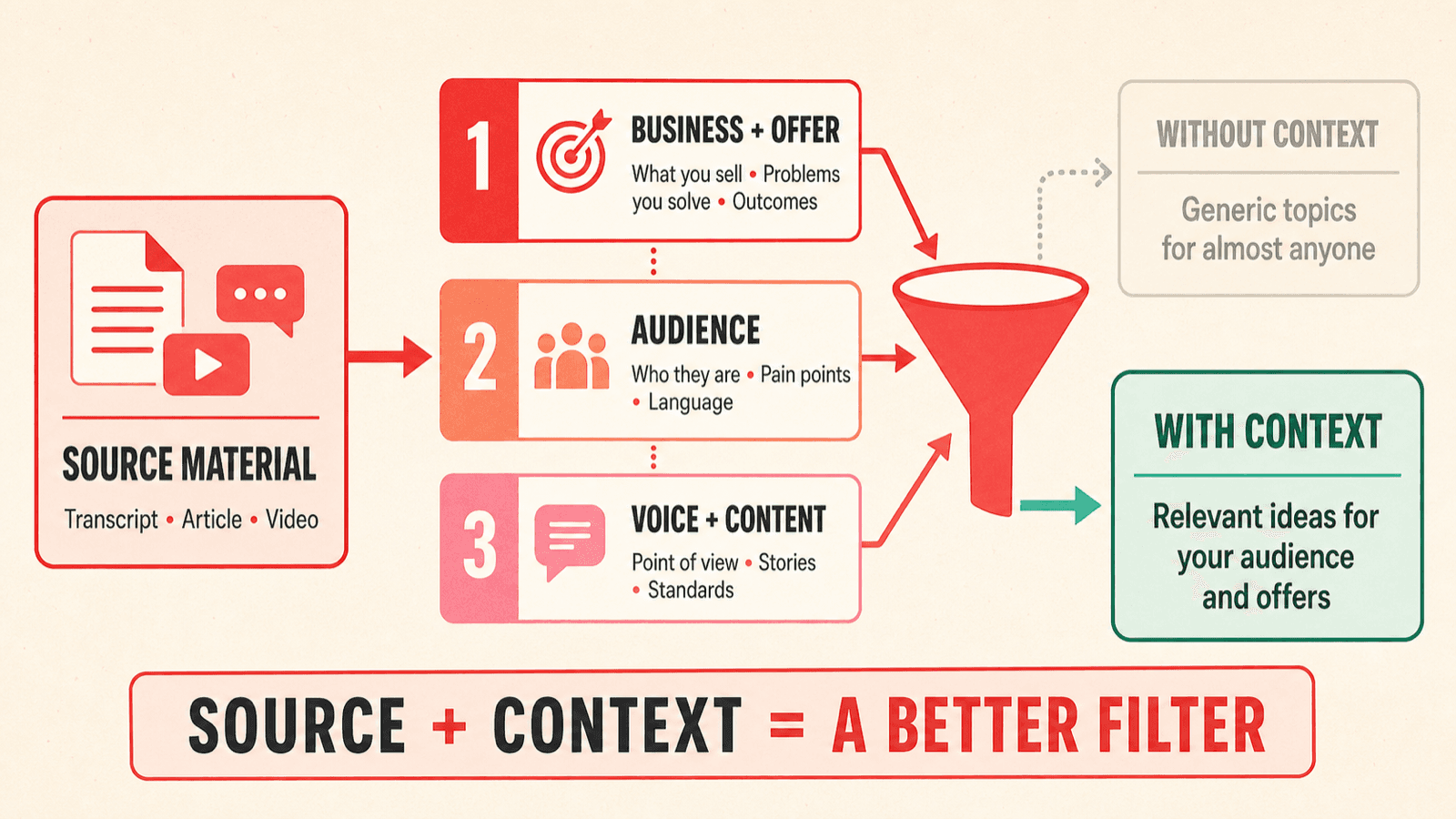
This isn’t magic. These foundational files give AI the criteria it needs before it starts selecting ideas that you care about.
Business and offer context
This file explains what your business does and what people can get from you.
It should cover the problems you help solve, the offers you have now, the outcomes those offers support, and the boundaries around what you do.
The point isn’t to force a sales pitch into every piece of content. Instead, it helps AI recognize ideas that you or your business can talk about with credibility.
Without it, AI may find an interesting topic that leads your audience toward a problem you don’t solve. You end up publishing content that gets attention and creates no real connection to the rest of your work.
Audience context
This file explains who you’re talking to.
Roles and demographics can help, but I care more about the situation someone is in. What are they trying to do? Where do they get stuck? What have they already tried? What questions do they ask? What words do they use when they describe the problem?
For my own content, I’m usually talking to capable founders, consultants, operators, and small teams. They may already use ChatGPT or Claude. They don’t want to become AI engineers. They want the work to move without every decision waiting on them.
That context changes what AI should extract from a transcript.
A passing comment about repeating the same explanation every week may be more useful than a speaker’s polished 10-minute framework. AI wouldn’t know what to prioritize unless it understands the audience and the problem.
Voice and content context
This file explains how you think and what makes a piece of content feel like yours.
It can include your point of view, recurring themes, useful stories, words you naturally use, phrases you avoid, content formats, and the standards a draft has to meet before you publish it.
Voice is more than tone. It affects selection.
If your work focuses on human judgment, you may notice a moment where someone describes making a hard call with incomplete information. Someone focused on productivity may select a completely different moment from the same source.
The voice and content file helps AI look for ideas that fit your body of work, instead of dressing up generic topics in your writing style after the fact.
What changes when AI reads all 3
Let’s say you paste in a transcript where someone talks about spending hours every week rewriting work their team sends them.
Without context, AI might suggest:
How to improve team communication
With the 3 files, it may recognize a more specific idea:
Your team keeps bringing decisions back to you because the quality standard still lives in your head.
The second idea connects the source to a real audience problem. It also connects to work I can help with: extracting the decisions, examples, and standards that make a handoff usable.
The AI didn’t become smarter between those 2 attempts. It had a better filter.
You can use the same system when you’re learning from someone else’s article or video. Pull out the questions, tension, examples, and claims that connect to your audience. Then add your own analysis and perspective.
Build the files once, then keep iterating
Your first version won’t be perfect. But that’s fine and 100% expected.
The most useful part about this is that you no longer have to rebuild the context from scratch every time you open a conversation. You give AI the 3 files, add the source you want to mine, and tell it the outcome you want to achieve.
Then pay attention to where things go wrong.
If it keeps suggesting topics that don’t connect to your offers, improve the business context. If the ideas don’t hit the mark regarding what your audience cares about, improve the audience file. If the drafts sound too polished, your voice and content context needs more real examples and clearer boundaries.
The files will get better as you use and update them.
I put together a free guide with all 3 templates, copy-ready prompts, public Markdown reference files, and a ZIP download you can keep with your own business files.
Get the Content Idea Context Kit
Keep building.
-Tam